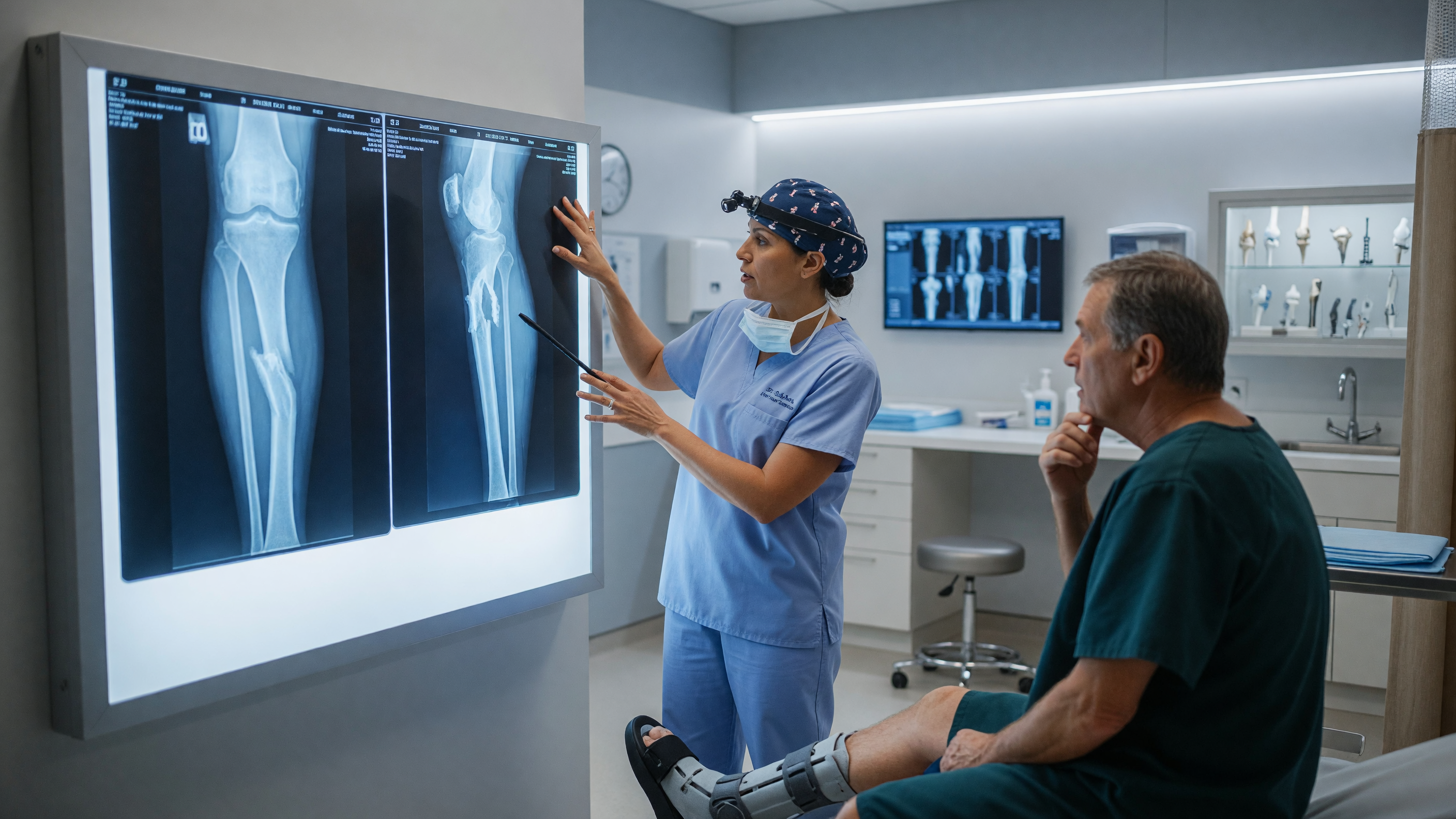
Malunion needs corrective surgery when a healed fracture leaves a deformity that causes pain, limits movement, shortens or twists a limb, or threatens nearby joints. Not every malunion requires an operation—mild cases may only need monitoring. This article explains what malunion is, the warning signs that point toward malunion surgery, how doctors diagnose it, the surgical options available, and recovery expectations. You will also learn when to see a specialist and why timely treatment protects long-term joint health. Use it to understand your options and make informed decisions with your orthopedic surgeon.
What Is Malunion?
Malunion happens when a broken bone heals in the wrong position. The fracture unites, but with angulation, rotation, or shortening that changes the bone's normal shape.
This differs from nonunion, where the bone fails to heal at all. A malunited fracture is healed but misaligned.
Malunion can affect how you walk, grip, or bear weight. Common sites include:
- Wrist and forearm bones
- Thigh and shin bones
- Collarbone and shoulder
- Ankle and foot bones
- Hip and pelvic region
If a healed fracture still looks or feels wrong, get it assessed at Lux Hospitals.
Why Malunion Happens
Malunion usually develops when a fracture is not aligned or stabilised properly during healing. Movement or poor positioning lets the bone set crookedly.
Some breaks are simply unstable and prone to shifting. Recognising the causes helps prevent repeat problems.
Common reasons behind malunion include:
- Inadequate initial fracture alignment
- Early or excessive weight-bearing
- Unstable or complex fractures
- Delayed or missed treatment
- Severe osteoporosis weakening bone
- Poor cast or fixation support
1. Persistent Pain and Weakness
Ongoing pain long after a fracture should have healed is a key sign that corrective surgery may be needed. Misaligned bone stresses muscles and ligaments.
Weakness or fatigue during daily tasks often follows. These symptoms rarely improve on their own.
Watch for warning signs such as:
- Pain beyond expected healing time
- Aching with activity or weight
- Muscle weakness around the site
- Discomfort that disrupts sleep
- Reduced grip or push strength
Don't ignore pain in a healed fracture—book an evaluation at Lux Hospitals.
2. Visible Deformity or Angulation
A bone that looks bent, bowed, or twisted after healing often signals significant malunion. Even small angles can affect function.
Deformity near joints is especially concerning because it shifts how force travels through the limb.
You may notice:
- A visible bend or bump
- Bowing of the arm or leg
- An uneven or crooked limb
- Asymmetry compared to the other side
- A joint that no longer lines up
3. Limited Movement and Function
When malunion blocks normal range of motion, surgery is often considered. Misaligned bone can jam against joints or tendons.
This limits everyday activities like reaching, walking, or lifting. Stiffness that persists despite therapy is a red flag.
Signs of functional loss include:
- Difficulty bending or straightening
- Trouble rotating the forearm
- Reduced walking distance
- Problems gripping objects
- Stiffness unresponsive to physiotherapy
Struggling with a stiff, misaligned limb? The specialists at Lux Hospitals can help.
4. Limb Length or Rotation Changes
Malunion can shorten a limb or leave it rotated inward or outward. These changes alter balance and gait.
A limb length discrepancy in the leg may cause limping, hip pain, or back strain over time.
Key concerns include:
- Noticeable leg length difference
- Foot turning in or out
- Limping or uneven stride
- Back or hip pain from imbalance
- Difficulty wearing normal footwear
5. Threat to Nearby Joints
A malunion that changes how weight loads a joint can speed up cartilage wear. This raises the risk of early arthritis.
Corrective surgery aims to realign the bone and protect the joint before damage becomes permanent.
Joint-related warning signs include:
- Early joint pain and swelling
- Grinding or catching sensations
- Uneven cartilage wear on scans
- Progressing stiffness near the joint
- Signs of developing arthritis
Protect your joints from long-term damage—consult Lux Hospitals about malunion surgery.
When Surgery May Not Be Needed
Not every malunion requires an operation. Mild misalignment that causes no pain or limitation may simply be monitored.
Your surgeon weighs deformity severity, symptoms, age, and activity level before recommending surgery.
Non-surgical management may suit you when:
- Deformity is small and stable
- Pain is minimal or absent
- Function remains near normal
- Joints are not at risk
- You have high surgical risk factors
Unsure if you need surgery? Get a clear, honest assessment at Lux Hospitals.
How Malunion Is Diagnosed
Diagnosis combines a physical exam with imaging to measure the deformity precisely. Your surgeon checks alignment, movement, and symptoms.
Comparing the injured limb with the healthy side helps plan correction. Accurate measurement guides whether, and how, to operate.
Common diagnostic steps include:
- Detailed clinical examination
- X-rays of both limbs
- CT scans for complex deformity
- Rotation and length measurements
- Assessment of nearby joint health
Treatment Options at Lux Hospitals
Corrective surgery usually involves re-cutting and realigning the bone, then stabilising it until it heals. The right technique depends on the deformity.
For many patients, proper fracture treatment and realignment restore function and relieve pain.
Available surgical approaches include:
- Corrective osteotomy to realign bone
- Internal fixation with plates and screws
- Intramedullary nailing for long bones
- Ilizarov ring fixator for complex cases
- Joint replacement when arthritis is advanced
- Bone grafting to support healing
Explore advanced deformity correction with the orthopedic team at Lux Hospitals.
Why Choose Lux Hospitals?
Lux Hospitals offers experienced orthopedic surgeons and modern imaging for precise deformity correction. Each treatment plan is tailored to your anatomy and goals.
From diagnosis through rehabilitation, you receive coordinated, patient-focused care.
What sets our care apart:
- Experienced orthopedic and fracture specialists
- Advanced imaging and surgical planning
- Full range of corrective procedures
- Dedicated physiotherapy and recovery support
- Personalised, honest treatment advice
Book your consultation with the best orthopedic surgeon at Lux Hospitals today.
Conclusion
Malunion needs corrective surgery when a healed fracture causes lasting pain, visible deformity, restricted movement, limb length or rotation changes, or threatens nearby joints with early arthritis. Mild, symptom-free malunions may only require monitoring, so expert evaluation matters.
The right choice depends on your symptoms, deformity severity, and lifestyle goals. Timely diagnosis and treatment protect your long-term mobility and joint health. If you suspect a fracture healed in the wrong position, don't wait for the problem to worsen. The orthopedic specialists at Lux Hospitals can assess your condition, explain your options clearly, and guide you toward the safest, most effective path back to pain-free movement.